Tuesday, 14 January 2014

Europe has to invest more in CCS technology

European Parliament urge Member states and the EU to develop the sector

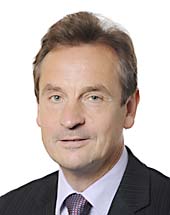
Alde MEP Chris Davies
by Emiliano Biaggio

Carbon capture and storage (CCS) projects should be encouraged, said the European Parliament on Tuesday. The Plenary adopted at great majority (524 votes in favour, 141 against and 25 abstentions) a report in which is highlighted the importance of CCS technology, suggesting to invest in research in such a field. The report is a non-legislative text, so it's not legally binding. What is important is the political message sent by the EU Parliament: inside Europe the debate on CCS is ongoing, and the carbon capture and storage projects begin to be considered as the next energetic frontier.«CCS deployment - is written into the report adopted in Strasbourg - has the potential to allow the EU to meet its 2050 low-carbon aspirations at least cost and is necessary in particular for decarbonising high CO2 emitting industries». MEPs believe that it may also «contribute to the diversity and security of energy supplies» while maintaining and creating employment opportunities. For all these reasons the European Parliament calls on the Commission to «consider creating» an EU industrial innovation investment Fund to support the development of innovative climate-friendly technologies including CCS flagship projects. Such a tool could be financed from the sale of allowances from the EU ETS, without leading to a new demand on the EU budget, suggests the report. Given the investments needed, instruments in addition to the EU ETS «would be needed» to stimulate research and application of CCS. MEPs have no doubt: there's no time to waste. On the contrary, there is «the urgent need» to develop a range of full-chain CCS flagship projects so as to identify the best and economically most advantageous solutions, and all that depends on the Commission. «Our aim should be not only to reduce Europe’s CO2 emissions but also to do so at the least-possible cost», explained Chris Davies (Alde), rapporteur of the document. «CCS technology can allow us to use fossil fuels to keep the lights on even when the wind is not blowing and the sun is not shining».

Sunday, 12 January 2014

Available on-line Italiani per definizione, Emiliano Biaggio's last book. A portrait of a society and the image of a country through its people. A short novel in which is offered a panoramic view on the way of being typical of the Italian style. A book to try to understand what Italian means today. Available only in Italian, the book is readable by clicking here or by clicking on the web link at the bottom of Biaggio's book section on the right.

Saturday, 11 January 2014


Israel cries for Sharon's death


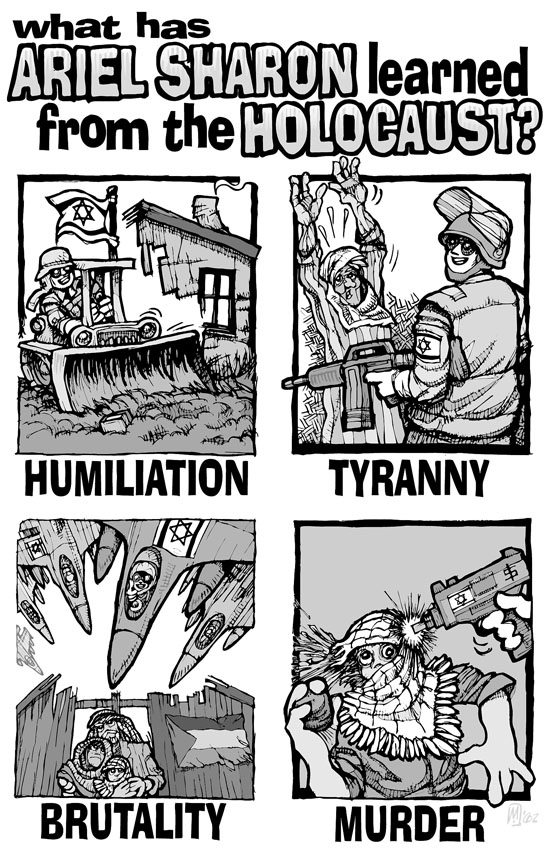
Former Israeli prime minister Ariel Sharon died today after eight years of permanent vegetative state for a stroke suffered on 4 January 2006. Serving the country as a soldier, only in the first years of the 70s' he started his political career. As a soldier, Sharon took part at the 1948 war of independence war, the 1956 Suez war, the six-day war and the Yom Kippur war; as a politician he served as a minister of Defense when occurred the Sabra and Shatila massacre: during the 1982 Lebanon war, between 800 and 3,500 Palestinian civilians in the Sabra and Shatila refugee camps were killed by the Phalanges—Lebanese Maronite Christian militias. The militiamen entered the Palestinian camps while Israeli forces surrounded the camps, blocking camp exits and providing logistical support. It was not proven Sharon's direct responsibility, but he had to resign and his image was compromised. Above we can see how Sharon has been considered by many cartoonists around the world, considering also his strong internal policy on Palestinian territories. For three decades - in the 1970s, 1980s, and 1990s - Sharon championed construction of Israeli settlements both in the West Bank and in Gaza strip. «Everything we take now will stay ours, everything we don't grab will go to them», explained at that time. Sharon is also considered by Palestinians to be responsible of their former leader Yasser Arafat, dead in 2004 in unclear circumstances when Sharon was acting head of the Israeli government. Israel today cries for Sharon, while Palestinians express regret he was not brought to justice before he died.

Thursday, 9 January 2014

ECB hold rates low but is ready to act

Draghi:  «Ready to consider all available instruments. Countries go on with reforms»

Mario Draghi
by Emiliano Biaggio

The European central bank doesn't change its policy: once again the Governing Council of the ECB decided to don't review the interest rate on the main refinancing operations, the interest rate on the marginal lending facility, and the interests rate on the deposit facility, which will remain unchanged at 0.25%, 0.75% and 0.00% respectively. «The Governing Council will maintain an accommodative stance of monetary policy for as long as necessary», reiterated ECB president Mario Draghi during the press conference held in Frankfurt after the governing council meeting. The Eurotower policy «will assist the gradual economic recovery in the euro area», added Mr. Draghi. So «we firmly reiterate our forward guidance that we continue to expect the key ECB interest rates to remain at present or lower levels for an extended period of time». With regard to money market conditions and their potential impact on monetary policy stance, «we are monitoring developments closely and are ready to consider all available instruments». Draghi came back to repeat what he already stated during the last three months: due to the economic conditions and the current background everything remain unchanged. The same has to be for all the Eurozone member states, which means to carry on with the current programme. «As regards fiscal policies, it is important not to unravel past efforts but to sustain fiscal consolidation over the medium term», emphasized the ECB president. «Fiscal strategies should be in line with the fiscal compact and should ensure a growth-friendly composition of consolidation which combines improving the quality and efficiency of public services with minimising distortionary effects of taxation». In Draghi's opinion «when accompanied by the decisive implementation of structural reforms, this will further support the gradual economic recovery in the Euro area and have a positive impact on public finances». To the governments of the eighteen there are clear suggestions. «Reforms in product and labour markets and a rigorous enactment of Single Market policies warrant particular focus to improve the outlook for economic growth and to foster job creation in an environment of high unemployment». There is still a lot work to do, underlined Draghi. The economy remains «fragile» and at the moment «is too early to declare the eurozone debt crisis over».

Wednesday, 8 January 2014

Quotes

«I really believe this year for Europe is going to be better than the last years, namely, in economic terms».
Josè Manuel Barroso, president of the European Commission, following the College visit to Athens for the start of the Greek presidency (Athens, 8 January 2014)

Job is not a business for young people

The number of the under 25 years old without a work rose again both in EU

by Emiliano Biaggio

In November 2013 youth unemployment rose across Europe, notices Eurostat in the latest bulletin issued today. At the end of the month concerned, there were over 5,6 million young people without a job in the EU, of whom more than 3,5 million in the euro area. In total the unemployment rate of the under 25 in November rose up 23,6% in the EU, 0,1% more than the previous month. In total, underlines the statistical office of the European Union, in November 2013 there were 28.000 unemployed more than October, of whom 6.000 in the euro area. Sweden (+17.000), France (+11.000) and Spain (+10.000) have been the countries with the highest rise of youth unemployment. Germany (-3.000), Italy (-3.000) and the Netherlands (-3.000) have been the EU member states with the strongest reduction of this trend.

Tuesday, 7 January 2014

bLOGBOOK

The flight is delayed. It happens. Shit happens. Ok, the departure is only fifteen minutes late, no problem! But as the proverb states, "a good beginning makes a good ending". In fact the end of this journey would have required a lot of time to come. Once landed, it appeared clear I would had to experience several inconveniences. Because of too much coins into the wallet, the latter got broken. When? Of course, right at the moment of paying the renew of public transport season ticket. So, for the joy of pickpockets, I had to put all the coins into the pockets. And of course, It appeared evident I would had to buy a new wallet. Both tube and tram, I have to say, arrived soon, almost immediately. That's nice when you have luggages. But what is not nice is to discover to be out. I mean out of the house. Once arrived at home the first operation to do is to open the door. It could sound weard, 'cause It's evident the door has to be opened and this is the first thing to to in order to come in. But It was not the case. Not for me. In front of the door I try to open, but the keyhole doesn't work. I try several time, but there's nothing to do. In the meanwhile a freezy wind starts to blow. Ok: be abroad, with no home where to go to, staying under the storm, is something normal. But in any case, what a fuck! Welcome back, man! Trying to reach the home owner is something complicated! She's always busy in her work, in her activities, and even if is possible to talk to her she's never in the condition to do anything. But there are no alternatives. I call her, and with great surprise she answers. And then I realize where the problem is: it's inside. There works ongoing in her apartment, and workmen are all around. Someone of them left the key into the keyhole, that's why it wasn't impossible to open the door. So I ring the bell, I explain who I am, and finally a men in coverall arrives to open. But, you know what? "a good beginning makes a good ending". So, if you have not a good beginning, everything could turn in tragedy. So, when finally I can came in I find a barricade in front of the door of my little apartment. It is made by the old fixtures just replaced by the workmen. "Ehm... I'm sorry", says the guy who opened the door of the building. "We didn't know there was a person living there. We remove immediately all this stuff". Ok, I know a thing at least: I know that I have time to go to the supermarket. I said at the beginning the everything would have required a lot of time to finish.

Saturday, 4 January 2014

Latvia, welcome to the euro era

The common currency started to circulate inside the Baltic republic with the arrival of the new year, making the country the member of the eurozone

by Emiliano Biaggio

Latvia is officially the eighteenth Euro area member state. The country introduced the european currency the 1st of January, and next thursday in Riga will be hold the celebrations for the historical event, both for Latvia and for European Union. For Latvia, after a cold war spent in the eastern bloc and after decades of communism and russian rule, the adoption of the euro represents the pick of the political and historical rebirth together with the beginning of the euro era; for the European Union the arrival of Latvia into the Europe-wide currency bloc represents another remarkable step towards a stronger integration. In Riga as well as in Brussels the political leader are celebrating this new chapter of the european history. The adoption of the euro «is a big opportunity for Latvia’s economic development», said the country’s acting prime minister, Valdis Dombrovskis, withdrawing the first 10-euro banknote. «For Latvia it is the result of impressive efforts and the unwavering determination of the authorities and the Latvian people», said European Commission president José Manuel Barroso, happy for the latvian performance of last hours. In fact, according to a EU Commission survey, by the end of Thursday 2 January, 30 % of payments in shops were being made in euro only and 94 % of customers were getting their change in euro. Furthermore «no major problems were observed in banks or in the retail sector». Latvia will conclude the changeover period in two weeks. National currency Lat recall will run until the end of the first half of the month: it means that from Thursday 16 January the euro will be the only circulating currency in Latvia. In Brussels they have no doubts: «Thanks to careful preparations, the start of the changeover has been successful». Into the Baltic republic, on the contrary, there is concern among the populations: part of Latvia’s two million people fear prices rise because of the introduction of the new currency.

Thursday, 2 January 2014

Italians, people without a nation?

Political leader and political parties invited the people to boycott the head of State. Something never seen before in Europe.

Giorgio Napolitano, Italian head of state
Opinion

For the new year's eve, as tradition wants, the president of the Italian republic prepared and gave his speech talking to the Nation. Nothing special, it happens every year. What made curious this speech was the party of  Lega Nord. Just to be clear it has to be sad that it was not the party to be curious - even if it is - but the fact the party invite all the Italians to ignore Napolitano's words. And the leader of the M5S party, Beppe Grillo, did it too. Perhaps it could be something absolutely normal for both Italy and the Italians, but there is something incredible in what happened before and during president Napolitano's speech. To make an example and having a comparison, could we image someone, in the United States, scream to not listen to the president speaking? No, we could not. We know perfectly there are things not at issue. And the figure of the president of the United States of America is one of those. For Americans, of course. And could we image a british invite his compatriots to don't care about the queen? Come on, be serious! It will never happen. That not because a queen or a federal president are different respect to the president of the Italian republic. It will never happen because of the respect for its own culture, for its own tradition, for its own history, for its own values. What in Italy seems to be at stake is the respect for people and institutions. Of course democracy does legitimate the disapproval, and it is always possible to express different opinion or/and critics, but in the right way. Because the highest institutions are the country. So in the U.S. the president represents the United Stated of America, all the fifty states, and similarly in the United Kingdom the queen represents the whole country. So, saying "let's ignore our president's speech" simply means "we don't care about Italy". It is clear to the world that the party of Lega Nord is interested more to the north of Italy rather than the rest of the country, but the impression - and maybe the reality as well - is that one of a country without any value or, maybe worse, without any reference point. If we consider that Giorgio Napolitano was reappointed for a second mandate by the same people who today invite to don't listen to a word, then we participate at one of the paradoxes made in Italy. What it appears to be more and more clear is the lack of national feelings into the italian minds. Perhaps did the Italians lose the idea of nation?