Monday, 3 March 2014

bLOGBOOK - Binche

Binche

Binche means Carnival. Everything here deals with Carnival. First of all, the popularity. In every guide and in every web page related to Binche, the first information available is that of one of the most interesting and typical Carnival of the kingdom of Belgium. To be honest, in Belgium there are two different events like that: the first one is that one we talk about, the second one is the Carnival of Aalst. Binche is in the French-speaking part of the country, Aalst in the Flemish-speaking zone. It's not a worthless difference. Binche, thirty thousands inhabitants or an a little further on, as the majority of Belgian cities has a story of passed glory to tell. Under the rule of the Holy Roman empire, in 1545 Charles V gave the medieval castle of Binche to his sister, queen Mary of Hungary, governess of the Netherlands. She made Binche her main residence, and organised great and lavish ceremonies for her brother the emperor. The city became soon a centre of great interest, and the vocation for joy and city celebrations started.
   At that time Binche was already well known: the famous Carnival Popularity belongs to the XIV century. It was in that moment the Gilles appeared for the first time. Gilles are the traditional masks. On Shrove Tuesday nearly one thousands people march though the city dressed with a linen suit with red, yellow and black heraldic designs (red, yellow and black are the colours of the Belgian flag), trimmed with large white lace cuffs and collars. The suit is stuffed with straw, giving the Gille a hunched back. They also wear wooden clogs and have bells attached to their belts. The costume is not worn: is put up to the people like it was an armour. The Gilles swear a papier-mâché mask of particular design. All the 1.000 people parading have the same face: green yeas, glasses, and red moustache and sideburns. The people go around from 4 o' clock in the morning until late hours, bringing traditional dances, songs and happiness for all those who join them. In 2003 the Carnival of Binche was proclaimed intangible heritage of humanity by UNESCO, entering the Carnival into the myth.
People at Binche in Carnival
  Nowadays is difficult to imagine Binche out of the Carnival framework, even because the city has not many other to can offer. Despite the position - one hour from Brussels by train (forty minutes by car) and less than twenty kilometers far from the French border - Binche during the rest of the year is a normal centre of Belgian province. A very quite place where to go to have relax, far from the noise of the city. The city park is one of the calmest area ever, and in sunny days it's possible to experience wonderful walks or nice pic-nic, drinking one of the beer made by "La Binchoise", the local brewery. In case, before leaving, have a look at the international museum of Carnival and masks, you are interested to know more on the Carnival. In it collection from all over the world show how Carnival is celebrated in the different countries of the globe. An important area is reserved for the that of Binche, of course.


The other destinations  visited

Amsterdam / Antwerpen / Berlin / Braine l'Alleud / Brugge / Budapest / De Haan / Den Haag / Durbuy / Gent / Halle / Knokke / Leuven / Liège / Mechelen / Mons / Namur / New York city / Oostende / Santiago de Compostela / Strasbourg / Tournai / Vilvoorde / Waterloo

Saturday, 1 March 2014

An historic vote brought Italian PD into PES

Party led by Matteo Renzi along the European Socialist after seven years of internal debate. «It's a starting point»

by Emiliano Biaggio

Italian Partito democratico (PD) joined the Party of European Socialists (Pes) after a internal disputes lasted almost a decade. The executive committee gave green light with a nearly unanimity vote (121 votes to 1, with 2 abstentions), making PD the 32th PES member party. PD had a strong debate over its position within the European parties since its creation, in 2007. Formed by the union of Democrats of the Left party (heirs of the Italian Communist Party- PCI) and Democracy is Freedom – The Daisy, PD never was able to join PES because of the strong opposition of Christian leftists. Now, after seven years, PD finally won the internal resistances. «Joining PSE marks a finish line, but it marks a starting point as well», stated PD secretary and Italian prime minister, Matteo Renzi. «A debate on Europe is clearly a never ending debate. Europe is the theme of our future». «We have a historic opportunity to set a new path in Europe», was the of Federica Mogherini, new Italian Foreign minister and close Renzi's ally. «The Democratic party is delighted to bring its strength and support to the PES for this campaign and for the future». The application of the Italian Partito democratico was accepted by PES with unanimous backing. «We are delighted to welcome the PD into our progressive family», said after PES meeting the president of the European socialists, Sergei Stanishev. «This is a beautiful moment for us».

Thursday, 27 February 2014

EU hypocrisy led anti-prostitution vote

In Strasbourg MEP's passed a non-binding and not credible resolution

by Emiliano Biaggio

Punish the client, not the prostitute. That's what the EU wants to do in order to tackle sex business in Europe. A non-binding resolution adopted by the European Parliament on Wednesday call countries to reduce the demand for prostitution by punishing the clients, imposing them new fines and set stricter rules for all customers. The proposal - passed with 343 votes to 139, with 105 abstentions - suggests to introduce across Europe the so-called "Nordic model". This is followed by Sweden, Iceland and Norway: here prostitution is considered as a violation of human rights and as a form of violence against women, and for such a reason the law criminalises those who buy sex rather than those who sell it. «We send a strong signal that the European Parliament is ambitious enough to tackle prostitution head on rather than accepting it as a fact of life», said MEP Mary Honeyball (S&D, U.K.), who drafted the resolution. Question of point of views. The reality is the European Union proved to be hypocrite, acting not to dismantle the international illegal human traffic that lies behind the prostitution. Of course, it's easier take countermeasures on the demand side rather than to that one of the offering, but in line of principle it become automatic to ask ourselves what situation is worse between committing a crime (reducing a woman into slavery forcing her to offer sex) and take advantage from it (buying sex from a person already reduced into slavery and forced to offer sex). To confirm the hypocrite nature of the resolution adopted in Strasbourg there's the paragraph where is written that buying sexual services from prostitutes under the age of 21 should be a criminal offence in the entire EU. Does that mean if the prostitute is over 21 is there no criminal offence? So, how to conciliate that with the principle of the "Nordic model" by which prostitution is a violation of human rights and a form of violence against women? Something is wrong in Europe. EU institutions and European leaders warned populism is a danger, but in reality they act as they were the first populists. The problem is they don't realise it.

Tuesday, 25 February 2014

EU out of the crisis, but recovery still modest

The economic forecast of the European Commission show the worst is passed, but reforms remain key

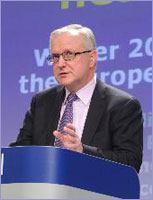
Olli Rehn
by Emiliano Biaggio

Europe turned page, leaving the crisis behind it. It's the main result shown by the winter economic forecast of the European Commission, released today in Strasbourg. GDP is expected to increase from 0,1% in 2013 up to 1,5% in 2014 and up to 2% in 2015, while the Gross domestic product of the Euro area will better underline the positive trend passing from contraction (GDP at -0.4% in 2013) to expansion (GDP at +1.2% in 2014 and +1.8% in 2015). Good news come from the unemployment forecast, too. Employment growth is set to accelerate, resulting in a slight reduction of unemployment from 10.9% in 2013 to 10.4% in 2015. Of course - pointed out the European commissioner for Economic affairs, Olli Rehn - the forecast remains based on the assumption that the implementation of agreed policy measures at EU and Member State level sustains improvements in confidence as well as financial conditions and advances the necessary economic adjustment in Member States, by increasing their growth potential. «To make the recovery stronger and create more jobs, we need to stay the course of economic reform», he stated. The forecast, he added, suggest that «recovery is gaining ground in Europe», but a lot has to be done. «The worst of the crisis may now be behind us, but this is not an invitation to be complacent, as the recovery is still modest».


Read the document

Gilberto Forti, moderne poète maudit

En 1984 publia un livre sur la guerre un des plus intéressant. Oublié par tout le monde

Gilberto Forti
Emiliano Biaggio

La guerre peut-elle être racontée avec de la poésie? Gilberto Forti (Rome, 12 avril 1922 – Milan, 15 novembre 1999), journaliste et écrivain italien, a voulu utiliser les vers pour parler de la première guerre mondiale et des changements que le conflit même a déterminé. Dans son livre À Sarajevo, le 28 juin Gilberto Forti donne une version très particulière des événements grâce à onze nouvelles en vers où l'histoire de l'Europe est décrite à partir de l’assassinat de l’archiduc François-Ferdinand, héritier de l'Empire austro-hongrois, par le nationaliste serbe de Bosnie, Gavrilo Princip. Cet événement fut l’élément qui fit éclater la première guerre mondiale. L'attentat de Sarajevo eut lieu le 28 juin 1914, et le livre de Gilberto Forti a été dédié à un des jours les plus importants de l'histoire.
Publiè en Italie en 1984, À Sarajevo, le 28 juin est devenu à l'occasion une oeuvre pour commémorer le soixante-dixième anniversaire du premier conflit mondial, dont cette année on célèbre le centenaire. À Sarajevo, le 28 juin ne parle pas seulement de la mort de François-Ferdinand, mais de toutes les fractures qui se produisent avec la guerre et des blessures qui aprés le conflit produiront les prémisses de la deuxième guerre mondiale. Plus simplement Gilberto Forti part de l'attentat qui tua l'archiduc François-Ferdinand pour décrire les changements d’une époque, en mettant ensemble la recherche historique et la poésie. Forti donne vie à onze histoires différentes, avec onze personnages fictionnels qui parlent et nous donnent des images et des descriptions des évènements, comme s'ils étaient des narrateurs. Le résultat final est tellement particulier que l'écrivain a du mettre en guarde les lecteurs dans la petite introduction:

N'ayez pas peur. À première vue
il peut sembler que ce soit de la poésie, mais ce sont des histoires
sur deux guerres, recueillies
par un rapporteur qui s'est perdu dans des vieux souvenirs.
Le texte, même s’il a des lignes inégales,
n'est pas différent d'une prose
avec noms, dates et lieux très réels.


 Les événements racontés par Gilberto Forti et par ses personnages sont en fait réels, même si parfois il peut sembler difficile à croire par le style utilisé et par la nature des histoires. On peut découvrir que François-Ferdinand il était obèse, et que pour le cacher il portait une tenue avec une gaine: c'est la raison pour la quelle il mourut. Le 28 juin 1914, quand le jeune étudiant serbe Gavrilo Princip tira sur le membre de la Maison de Habsboug, François-Ferdinand mourut parce-qu’il saignait et que personne ne savait comme ouvrir la tenue spéciale. Les personnages de Gilberto Forti nous le rappellent, et en même temps, à travers les paroles de Gavrilo Princip, les même personnages nous informent des changements qui se produisent. Après l'attentat Princip fut capturé et emprisonné dans la prison de Terezìn (aujourd'hui en République Tchèque), où avant de mourir il écrivit sa prophéthie:

Tracés sur le plâtre du mur
les derniers vers de Gavrilo Princip:
"Émigrerons à Vienne nos spectres
et y erreront par le palais"

Les fantômes de l'histoire à la fin de la guerre arrivent à Vienne: l'Autriche sera vaincu et l'empire austro-hongrois dissous. À Sarajevo, le 28 juin a été traduit en anglais et en français avec l'espoir de pouvoir le vendre à un niveau international, mais au contraire le livre n'a pas connu un grand succès et la maison d'édition en a interrompu la publication. Aujourd'hui il est donc difficille de pouvoir le trouver et c'est dommage.

Saturday, 22 February 2014

Italy to be less influential with Renzi?

New government doesn't include distinguished names to spend at international level. And there is no minister for European affairs in the year of Italian presidency of the EU.

Matteo Renzi
Opinion

Italy has a new government, as the president of the Republic gave to Matteo Renzi the responsibility of creating a new executive branch. The new prime minister already announced his team will be formed by sixteen minister, half of which composed by women. No great changes are expected, since the general political environment remains the same in which acted Enrico Letta, threw away by Renzi: the majority into the Parliament didn't change, since no new elections were held in Italy; the alliances didn't change, as Ncr leader Angelino Alfano will be part of the coalition; opposition is even stronger, as Renzi on one hand wasn't able to bring Beppe Grillo's Movimento 5 Stelle to his side, and on the other hand - working to reshape the government - produced SEL exit from the coalition. Renzi promised to put forward the necessary reforms, risks to have a brief life. Forza Italia leader Silvio Berlusconi pointed out the new prime minister benefits only of the majority of his party, so everything is possible. At the same time Berlusconi affirmed Forza Italia would win in case of new elections, showing all the weakness of the Democratic party. Renzi has to deal with a very sensitive moment, that could mark a point of no return for the Italian centre-left wing. Failing in his mission (with the word "his" meaning "personal", as nobody understood why Renzi decided to put an end to the previous government) Renzi would became politically unbearable, and Italy would turn to a dangerous situation in which the only relevant political forces would be those of the right wing - Forza Italia and Movimento 5 Stelle - without any counter-weight.
Another issue to address is the competence of Renzi's government: there are a lot of young people. It's a good choice, for a country with one of highest youth unemployment rate in Europe. Have the new minister the sufficient experience to be credible and effective, especially at international level? That's the question has to be asked and, above all, answered. Renzi gave a low-European profile to his team, with no ministers for European affairs. That's one of the first surprised created by Renzi's choices, with great surprises of a lot of people. In Brussels the EU institutions are not used to comment neither ongoing process nor internal affairs, but such a decision was reason of astonishment, considering Italy will get the rotating presidency of the EU Council on July. Furthermore there are no people known in Brussels, so Italy has to create a new credibility. The only name appreciated in Europe is that one of Pier Carlo Padoan, appointed minister of Economy, with previous offices in the World Bank, ECB and European Commission. All the other ministers will be people without any European profile, and Italy will have to deal with this situation. Andrea Orlando has been moved from the minister of the Environment to that on of Justice. Orlando is well known in Brussels: he was said unable to speak any foreign language, and it seems he had no bilateral meetings in his European works. If rumours are not rumours it's a problem. Again, Emma Bonino has been replaced by Federica Mogherini, whose best skill seems to be her loyalty for Renzi. Mogherini is younger than Bonino, and is normal she has less experience compared to her predecessor. On December 2013 Mogherini was appointed Democratic Party responsible for Europe. Will be enough to manage all the international dossiers? Italy is playing a risky game, imposed by personal reasons rather than practical needs. Renzi would like ruling the country until 2018. Good luck!

Yanukovych: «new elections for Ukraine»

Current president and opposition leaders reached an agreement to unlock the crisis.

source: the Indipendent
by Emiliano Biaggio

President Viktor Yanukovych and opposition parties reached a political peace deal for Ukraine, after days of clashed and riots in which over 100 people remained killed. The 2004 Constitution was declared entered to force, limiting the powers of the person serving as president of the Republic. Yanukovich agreed in fact to give up powers, hold early elections (to be held before the end of the year) and form a government of national unity. Parliament voted already to remove the minister of Internal affairs - considered responsible of using force against the population - a general amnesty for all the protesters and all those have been arrested in the last weeks, and adopted a bill for changes to the legal code that could see the release of Yanukovich's jailed rival, opposition leader Yulia Tymoshenko. The deal will was made possible thanks to the mediation of the European Union and Russian efforts to solve a crisis seen with concern even in Moscow. From Brussels come the request to ensure justice. «I call for urgent independent investigations into human rights violations», the first comment by the High Representative of the European Union for Foreign affairs and security policy, Catherine Ashton. «Those responsible must be brought to justice». The EU now wants all the main element of the deal can be translated in concrete acts. «Implementation is key», and «it is very important that the elections take place in proper time». Russian reaction were different: president Putin welcomed the deal, but at the same time suspended the economic aid promised to the Ukrainian government because of the uncertainty of the situation. Protesters in Kiev and observers worldwide are concerned about the future of the country: Ukraine remains fragile, and compressed by European and Russian pressures.

Thursday, 20 February 2014

PES first party in Europe, said poll

Today Socialists would gain the largest number of seats into the Parliament, but anti-European movements are growing

by Emiliano Biaggio

Party of European Socialists (PES) is the first European party, according to a poll published today by PollWatch2014, the initiative launched by VoteWatch Europe and Burson-Marsteller/Europe Decides in the light of the next European elections. On May European citizens across the EU are called to elect the new European Parliament, where at the moment the biggest party is the European Popular Party (EPP). The latter could risk to loose their leadership as the majority of the European citizens told PollWatch2014 they want to vote for PES. According to the poll Socialists would gain 221 seats compared to the 202 got by EPP. A clear message for the EPP headquarters, where is still unclear who'll be the candidate who will run for the presidency of the European Commission. It seems that this provisional result shown by the poll depends on the fact the Party of European Socialist has already an official candidate (Martin Schulz). In general it seems the real winners of the next European elections will be the euro-skeptic groups, since the three main political parties are supposed to loose their power. According to PollWatch2014, compared to the current situation EPP, PES and ALDE together will loose in total around 7% of the seats (from 72% to 65%).

Chaos in Ukraine, EU calls for sanctions

Dozens killed in Kiev for clashes against police, Europe to take actions

by Emiliano Biaggio

The European Union considers the possibility to establish targeted sanctions after the latest events in Ukraine, where twenty six people died in riots in Kiev. Protester are still on the streets to ask for Vicktor Yanukovych's resignation and a new government. In Brussels an extraordinary meeting of the Foreign affairs council was summoned immediately after the announcements made by the media. «All possible options will be explored, including restrictive measures against those responsible for repression and human rights violations», stated Catherine Ashton, High Representative of the Union for Foreign Affairs and Security Policy. «We expect targeted measures against those responsible for violence and use of excessive force can be agreed by our Member States as a matter of urgency», added Josè Manuel Barroso, president of the European Commission. In Brussels the twenty eight member state are in search of a common position, but the situation is not a simple one. Russian president Vladimir Putin made clear he will never accept any EU interference in Ukrainian affairs. The situation was made even more sensitive after Ukrainian athletes in Sochi left the Olympic games because of the deterioration of the situation in Ukraine. Martin Schulz, the president of the European Parliament, reiterated that «what we need urgently is a threat of credible targeted sanctions», but at the same times he called for concrete proposal to offer to Kiyv, what was missed when the local government decided to refuse the Association agreement with the EU and to accept the financial offers made by Russia. «We need a credible offer of important financial aid if the situation is resolved peacefully and a political solution is found», said Schulz, but the impression is he did too late. The EU had to arrive to the negotiations with a economic package in order to provide a valid alternative to the Russian pressures. Now the extraordinary Foreign affair council meeting has to produce what Europe was not able produce in the previous months: a common position and a concrete economic offering to drive Ukraine to join the EU.

Monday, 17 February 2014

Quotes

«I would argue that the European Union is stronger with the United Kingdom in it. The truth is outside the EU the UK would lose influence».
Viviane Reding, vice-president of the European Commission in charge for Justice, speaking during the Mckanzie Stuart Lecture (Cambridge, 17 February 2014)